How to Choose the Right Model for Your AI Agent
Artificial IntelligenceA method for comparing AI models by quality, cost, speed, data constraints and the results they achieve on your own tasks.
The model is the engine of an AI agent. It interprets instructions, analyses the available information, may choose a tool, and produces a response or an action. It therefore has a direct effect on output quality, processing time and the cost of every run.
Yet choosing the model with the highest general score is rarely a sound method. An agent that summarises customer enquiries, prepares a document or retrieves information does not have the same requirements as one that edits code or analyses a complex case. The right choice starts with the actual task.
I recommend using public leaderboards to shortlist a few candidates, then comparing them on your own use cases. Benchmarks guide the search. Your business evaluation makes the decision.
Why the most intelligent model is not always the right one
An intelligence score combines several capabilities. It helps position a model quickly, but it cannot tell you on its own whether that model will solve your problem correctly, within the expected time and at an acceptable cost.
A few extra points may require more reasoning, generate more tokens and slow the run down. That difference can be justified: an error in a financial analysis or a sensitive document may cost far more than the model call. For a simple, repeatable and easily checked task, the same performance level may be unnecessary.
Volume magnifies the trade-off. A difference of a few cents seems insignificant in an isolated test. It matters when an agent handles thousands of requests, calls the model several times during a single run or retries after a tool failure.
The right model is therefore not the most powerful in absolute terms. It is the one that reaches the required quality while keeping cost, speed and risk compatible with your activity.
Start with the task assigned to the agent
Before opening a comparison tool, describe exactly what the agent must achieve. A statement such as “answer customers” is too broad to select a model. You need to define the available inputs, authorised actions and expected output.
I usually start with the following questions:
- what information does the agent receive, and in which languages?
- does it only write, or must it retrieve data and use tools as well?
- what outcome makes the task successful?
- which errors are acceptable and which ones are blocking?
- does a person approve the response before it is used?
- how many tasks will be processed, and within what time?
- is the data personal, confidential or governed by an internal policy?
These answers turn an abstract model preference into observable criteria. A background agent may be allowed to run for several minutes. Live assistance needs a fast first response. A low-risk task may prioritise cost. A sensitive decision may require human approval and a higher quality threshold.
Shortlist models with benchmarks
Artificial Analysis compares models across intelligence, cost and performance. Version 4.1 of its Intelligence Index combines nine evaluations covering agentic work with deliverables, tool use, coding, scientific reasoning, knowledge, hallucinations and long-context reasoning.
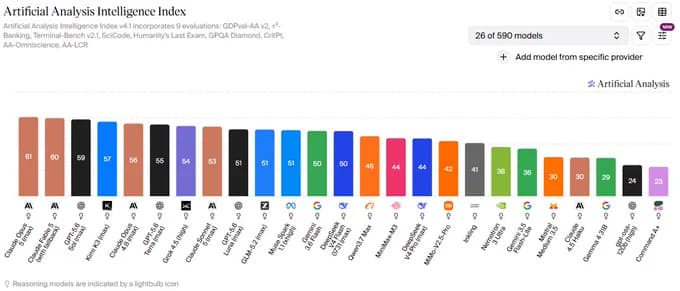
The index gives substantial weight to agentic tasks, which makes it useful for an initial shortlist. Its methodology also states two important limitations: the suite is English-language and text-only. It does not automatically represent your language, documents, tools or business rules.
It is therefore better to study the evaluations closest to your use case rather than relying only on the overall score. For an agent that produces files, a deliverable-based evaluation will be more informative than a scientific test. For an agent that runs commands or calls tools, agentic and coding performance deserve more weight.
Compare quality, cost and speed
The price per million tokens is useful for understanding an API’s pricing, but it is not enough to estimate the real cost of an agent. Two models can receive the same instruction and use very different amounts of reasoning and output.
Artificial Analysis’ Cost per Task metric brings the cost closer to the unit that matters: a completed task. It accounts for input, answer, reasoning and cache tokens used across the evaluations, then applies the index weights.
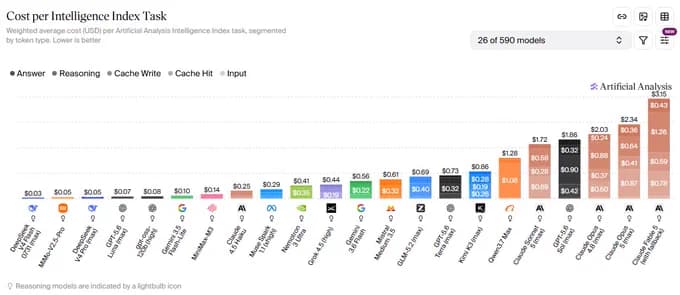
In this capture, GPT-5.6 Sol scores 59 at $1.86 per task, while Claude Fable 5 reaches 60 at $3.15. Their overall scores differ by one point, but the latter costs roughly 1.7 times as much on this measure. That does not prove that one is always the better choice. It shows why quality and cost need to be read together, at a specific point in time.
Speed is the third dimension. Artificial Analysis publishes an average generation time per task based on the number of output tokens and output speed. According to its definition, the measure excludes time to first token and other end-to-end overhead. A real agent also adds tool calls, retrieval, validation and network time.
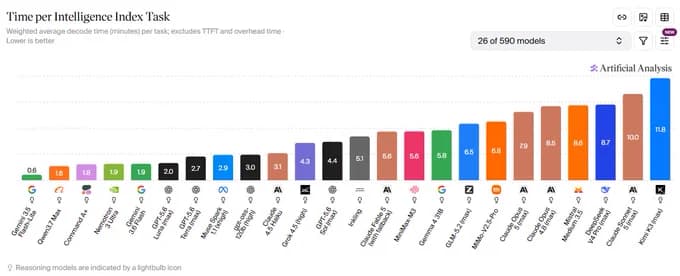
The public chart observed while preparing this Article ranged from roughly 1.5 to 13.5 minutes for the models leading the analysis, a gap of about nine times. That difference may be irrelevant for an overnight job and unacceptable in a live customer conversation.
Check hosting and data constraints
Performance is not the only deciding factor in a business. You also need to know who processes the data, in which region, with which sub-processors, for how long and for what purposes.
Artificial Analysis’ Openness Index measures weight availability, licensing and transparency about training data or methods. It is not a sovereignty index and does not guarantee where requests are processed. An open-weight model can be called through a provider outside Europe; a proprietary model may be offered in a European region.

For personal data, the European Commission explains that transfers outside the European Economic Area must rely on the mechanisms and safeguards provided by the rules. The European Data Protection Board’s guide also emphasises processor selection, contracts, security, sub-processors and international transfers.
A European region or self-hosting can simplify some decisions, but it does not guarantee GDPR compliance on its own. The complete processing operation must be assessed and, when necessary, reviewed by the person responsible for data protection or a qualified adviser.
Test models on your own use cases
After the shortlist, build a representative evaluation set. It should contain ordinary cases, difficult cases and situations in which the agent must refuse or request approval.
For every example, define what will be measured: factual accuracy, format compliance, tool choice, deliverable quality, absence of forbidden actions, total cost and processing time. Use the same instructions, data and tools for all candidates so the comparison remains meaningful.
A realistic evaluation does not stop at the final text. It checks the complete sequence: did the agent call the correct function, pass the right parameters, interpret the result properly and respond safely to an error? The most expensive failures often hide inside that chain.
Start with a few dozen carefully selected cases rather than a large, poorly defined collection. Add production incidents over time. The test set becomes a record of your requirements and makes it easier to assess a new model or version quickly.
Build a decision matrix
A simple matrix makes the trade-offs explicit. Its weights should reflect your activity, not the technical team’s preferences.
| Criterion | Example measure | Decision question |
|---|---|---|
| Business quality | success rate on your cases | does it reach the required threshold? |
| Agentic reliability | correct tools and parameters | does it act properly, including on failure? |
| Cost | average cost of a complete run | is it viable at the expected volume? |
| Delay | end-to-end completion time | does it fit the user journey? |
| Data | region, contract, retention, sub-processors | does it meet your constraints? |
| Operations | availability, limits, observability | can it be monitored and maintained? |
First remove models that fail a non-negotiable constraint. Then compare the remaining candidates by their quality, cost and speed. You can also use more than one model: an economical option for straightforward work and a more capable one only when difficulty or risk justifies it.
The best model is the one that succeeds at your task
Public leaderboards help you understand the market and avoid testing hundreds of options. They remain a snapshot built from a particular set of tasks, a methodology and a date.
To choose a model for an AI agent, start from the task, shortlist a few candidates, check the data constraints, then measure the complete result on your own examples. The choice becomes a documented and revisable decision rather than a bet on the best-known model or the highest score.